Image by Karen.t, Pixabay
Here’s the next instalment in ‘Questioning God’ - an exploration of questions in Scripture. It follows directly from last month’s blog, ‘Where are you?’
When Adam and Eve responded to God’s ‘Where are you?’ and reluctantly admitted their sin, God set to work. His first task - damage limitation. He banished them from the Garden of Eden so they couldn’t eat from the Tree of Life and live forever in their fallen state. Was this a fit of pique? Imagine you can look through the eyes of God. Watch, with divine foresight, the unfolding of human history – all the suffering that will be caused by man’s inhumanity to man. Now imagine humanity, including the worst of us (Hitler, Stalin…), possessing the philosopher’s stone – a material that endows immortality. The consequences are beyond imagination. Adam and Eve must be barred from Eden.
God’s second task - relationship restoration. The fig leaves are just not fit for purpose. God clothed Adam and Eve with garments of skin, to cover the nakedness of which they’re now ashamed. Thus, God made the first animal sacrifice, symbolically covering their sin.
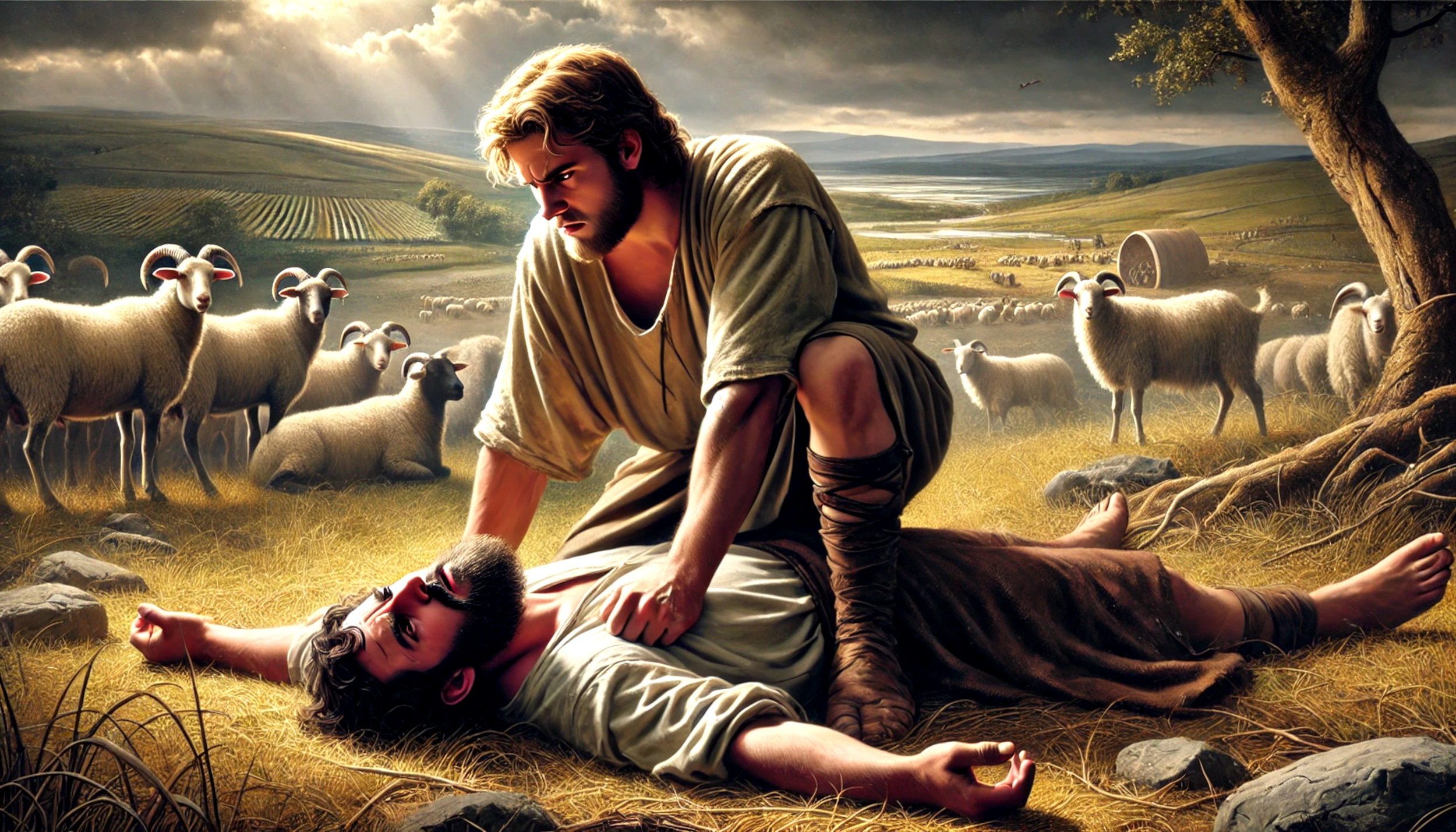
Time passes, and next in Scripture we meet the second generation, Cain and Abel. Cain is an arable farmer and makes an offering to God from the fruits of his soil. His younger brother, Abel, offers 'fat portions from some of the firstborn of his flock. The Lord looked with favour on Abel and his offering, but on Cain and his offering he did not look with favour. So Cain was very angry and his face was downcast.' Genesis 4: 4-5) Is God being capricious here or showing favouritism? No, the author emphasises that Abel brought the very best, whereas Cain didn’t. Cain sought to relate to God on his own terms. That's just not how the relationship works when one person created the universe and the other is a farmer.
God doesn't wash his hands of Cain. He draws near and asks him a series of questions to help him think through his response:
‘Why are you angry? Why is your face downcast [literally, falling]? If you do what is right, will you not be accepted literally, [lifted up]?’ (Genesis 4: 6-7)
The implication is clear. Cain, there's no need to go on feeling resentful and depressed. You can fix it! Just go and make a trade with your brother – your crops for his high-quality meat. Then bring the proper offering and all will be well.
Cain stands at a crossroads. God's voice beckons him to walk in the right path, one that involves collaboration with his fellow man and with God. Humility and teamwork. The other route is the way of 'I know best,' and 'Looking after number one.' Pride and going it alone. Do you hear echoes of the Garden of Eden? It’s like a mirror image: here, no serpent lures him towards darkness, but God coaxes him towards the light.
Don’t we all face moments like this? God’s whisper calls us to a better way, a path to true contentment, but our self-justifying independence yells, 'It's not fair!' and 'Why should I?
We saw how God provided the first sacrifice to cover Adam and Eve’s shame. In the fullness of time, he also provided the final sacrifice, his own Son, to cover the shame of us all. God’s love implores us to embrace the restoration He has provided.
‘If you do what is right, will you not be accepted?’
Will Cain listen to God’s voice or his own? Will I?